
Hips, knees and court movement in tennis
Court movement in tennis is mostly sideways: split step, push wide, stop, recover to the centre. That loads the hips, knees and ankles far more than running the same distance would. Court surface, spacing of match days and warmth on stiff areas are the practical levers.
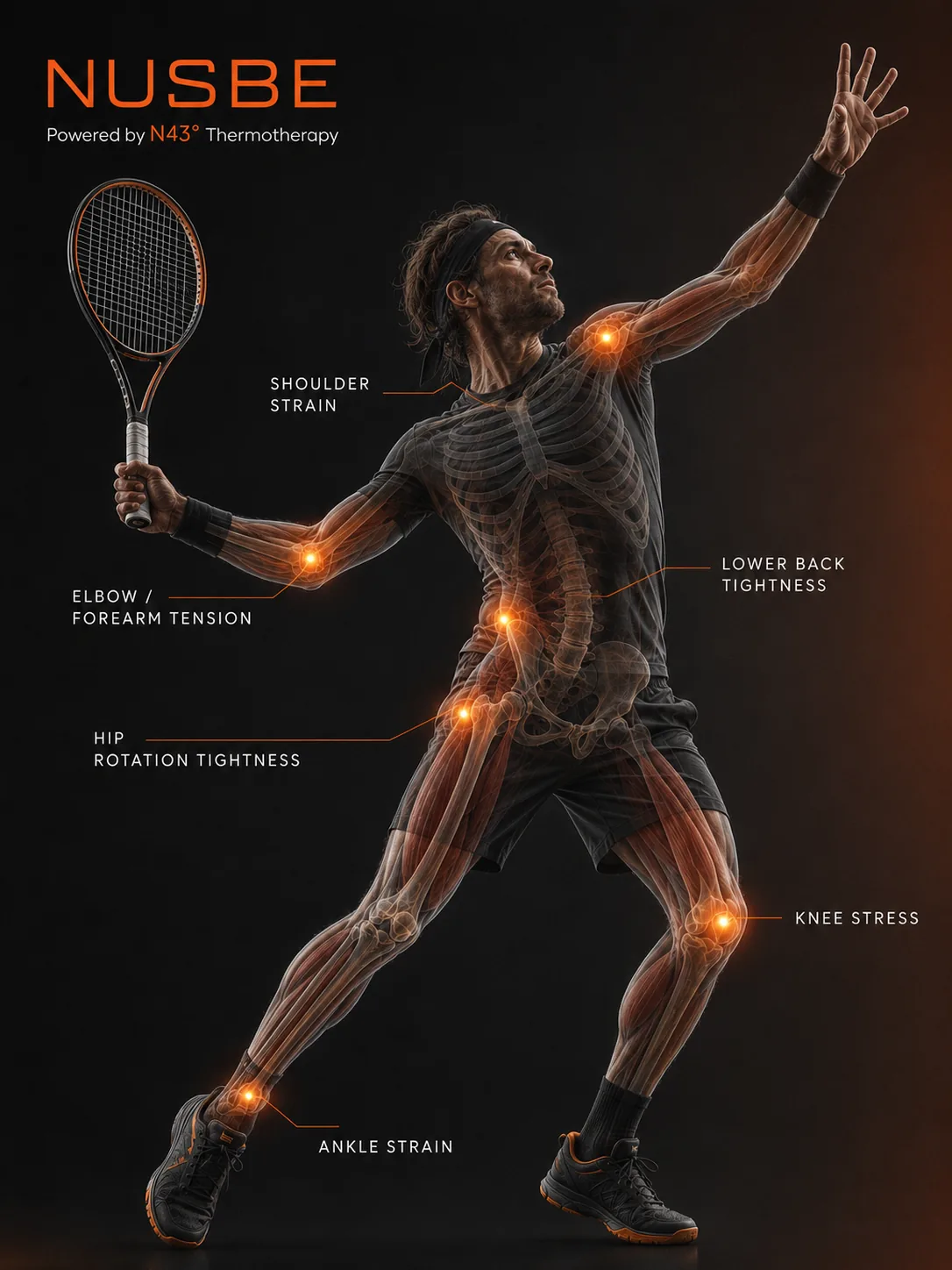
Sideways is the expensive direction
Add up the distance covered in a two-hour tennis match and it looks modest. Add up the stops and it does not.
Tennis movement is a loop: split step, push wide, plant, hit, push back to the centre. Each of those is a braking and re-accelerating event through the hip, knee and ankle. A match contains hundreds of them, and almost none of them are in a straight line.
That is why your legs can feel heavier after two hours of tennis than after a longer, further run.
What raises the load
- Hard courts, which give the force straight back rather than letting you slide. - Playing several days in a row, so nothing gets a recovery day. - Long matches in heat, where control drops off late and landings get heavier. - Coming back after a break and playing a full competitive match immediately.
What supports recovery
- Space heavy court days. The single most effective change for most club players. - Warm the hips up before playing, not during the first two games. - Rehydrate properly. In Malaysian conditions the fluid cost of two hours outdoors is substantial, and under-drinking makes the next day worse. - Build back gradually after any layoff. - Warmth for stiffness. With no acute swelling, controlled warmth may help ease stiffness across the hips, quads and calves between match days.
When it is not just soreness
See a qualified healthcare professional if knee pain is sharp rather than a general ache, if it sits at one specific point, if a knee or ankle swells or gives way, or if you rolled an ankle and it swelled.
That last one matters in tennis, where wide chases and hard stops make ankle rolls common. Playing on a swollen ankle is how a short problem becomes a recurring one.
Where NUSBE fits
A guided NUSBE session applies controlled, comfortable warmth to the hips, quads, calves and lower back at a consistent temperature and coverage. Players commonly book it the day after their heaviest match.
This is recovery and comfort support. It is not treatment, and it does not replace care from a qualified healthcare professional.
Frequently asked questions
Why do my legs feel worse after tennis than after a run of the same length?
Running is one repeated pattern in a straight line. Tennis is hundreds of stops, starts and direction changes, and each one is a higher-force event through the hip, knee and ankle.
Does court surface matter?
Players commonly report more leg load on hard courts than on clay, where you can slide into shots. If your soreness pattern changed when your usual court did, that is worth noting.
Why is my hip tight on one side?
Almost every shot is played from one side, and the push-off and rotation load one hip more than the other. Some asymmetry is expected; a one-sided pattern that keeps getting worse deserves a professional opinion.
What helps between match days?
Easy movement rather than complete rest, sensible spacing of hard court sessions, and warmth on whatever stays stiff once there is no acute swelling.
Evidence referenced in this guide
- Wang Y et al., Physical Therapy in Sport 2021 — meta-analysis of 32 randomised trials on heat and cold for post-exercise muscle soreness.
- Network meta-analysis of cold and heat therapies for DOMS, 2022 — hot packs ranked highest for early soreness relief.
See the research behind our recovery claims on the science page.