
The serve and shoulder load in tennis
The serve loads the shoulder more than any other shot, because the arm has to be accelerated overhead and then slowed down under control. Serving volume, not match count, is what tracks shoulder complaints. Spacing serving practice, warming up properly and warmth on stiff areas help; persistent shoulder pain deserves professional assessment.
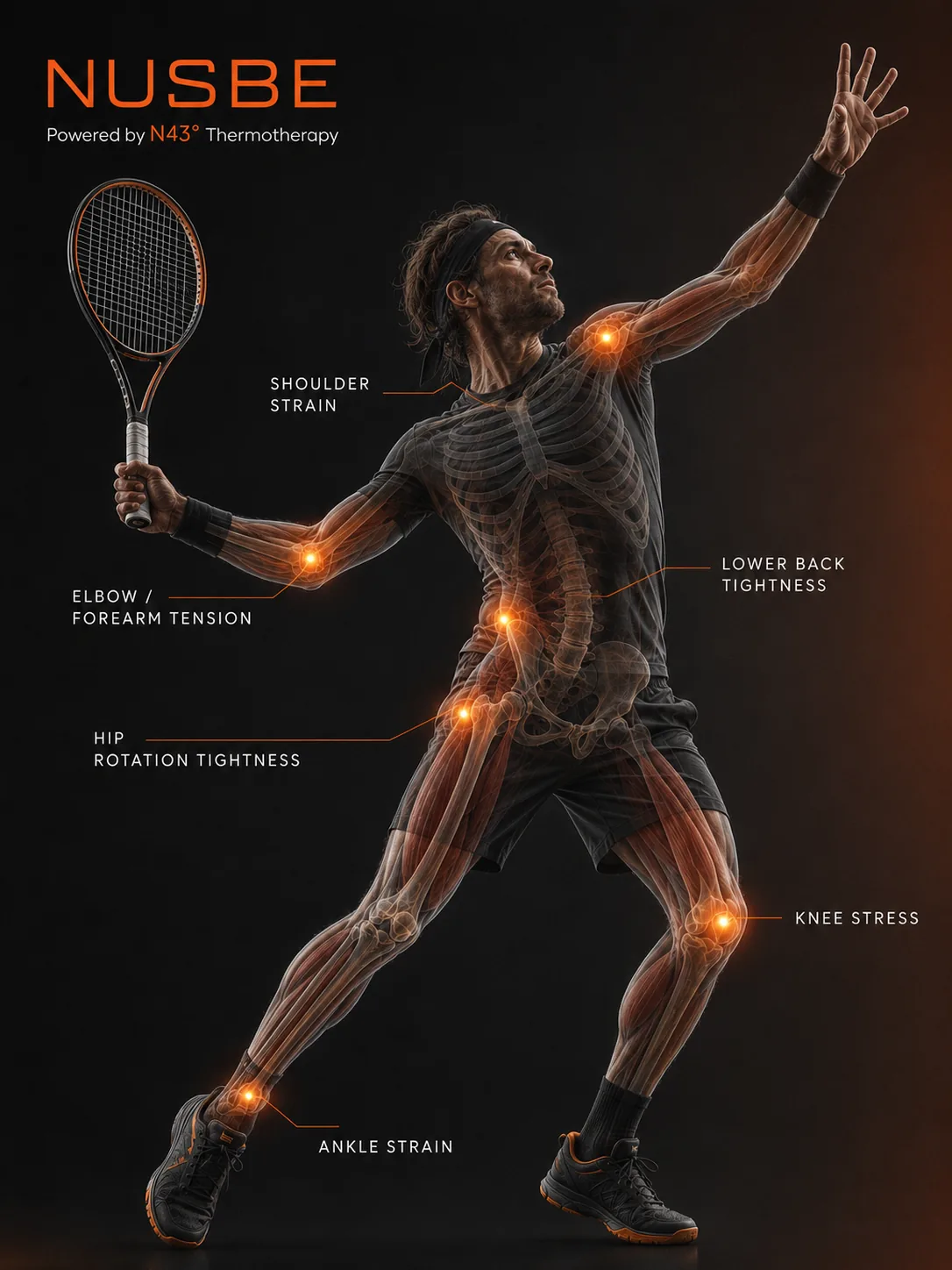
Two jobs, one shoulder
Players think of the serve as producing power. The shoulder does that, and then does something harder: it slows a fast-moving arm down, through a large range, several hundred times across a match and practice week.
That braking work falls on the muscles around the shoulder blade and the back of the shoulder. It is the part almost nobody trains directly, and it is the part most players feel the next day.
What tracks shoulder complaints
Not match count. Serving volume.
- A sudden jump in serving practice — a week of basket serving after months of none. - Serving hard when tired, late in a session, when mechanics quietly slip. - Starting a serving session cold. - A season with no lighter weeks in it.
Players who add serving practice gradually and keep at least one genuinely light week in the month report far less of the shoulder soreness that never quite clears.
What supports recovery
- Add serving volume in small steps and hold there before adding more. - Warm the shoulder properly before hitting serves at pace. - Space heavy serving from heavy match play. - Strength work over a season. Progressive work for the shoulder blade and rotator muscles supports serving volume; a professional can guide something suitable. - Warmth for stiffness. With no acute swelling, controlled warmth may help ease stiffness across the shoulder and upper back between sessions.
When to stop self-managing
See a qualified healthcare professional if pain wakes you at night, if the arm feels weak lifting overhead, if there is a sharp catch at one point in the service motion, or if it has been there for weeks rather than days.
Persistent shoulder pain in overhead athletes is well studied and has proper care pathways. Warmth is not the answer to it.
Where NUSBE fits
A guided NUSBE session applies controlled, comfortable warmth to the shoulder and upper back at a consistent temperature and coverage. Players commonly book it the day after their heaviest serving session.
This is recovery and comfort support. It is not a medical assessment, and it does not replace care from a qualified healthcare professional.
Frequently asked questions
Why is the serve so demanding for the shoulder?
It combines a large overhead range with high speed, and the muscles around the shoulder blade have to decelerate the arm afterwards. That braking work is what most players never train and most often feel.
How much serving is too much?
There is no universal number, but a sudden jump in serving practice is the common thread in shoulder complaints. Adding baskets gradually rather than doubling in a week is the practical approach.
Should I ice or warm a sore shoulder?
If the area is swollen or freshly irritated, short ice applications are the sensible first choice. For general stiffness with no swelling, warmth may help ease the tightness.
When is shoulder pain more than soreness?
Pain that wakes you at night, weakness lifting the arm, or a sharp catch at a specific point in the service motion should be assessed by a qualified healthcare professional rather than managed with recovery routines.
Evidence referenced in this guide
- Wang Y et al., Physical Therapy in Sport 2021 — meta-analysis of 32 randomised trials on heat and cold for post-exercise muscle soreness.
- Network meta-analysis of cold and heat therapies for DOMS, 2022 — hot packs ranked highest for early soreness relief.
See the research behind our recovery claims on the science page.