
Why you're sore after tennis, and how long it lasts
Tennis soreness comes from serving, trunk rotation and repeated sideways push-off, so it lands in the shoulder, forearm, lower back, hips and legs. For most players it peaks a day or two after a match and settles within a few days. Easy movement, spacing court sessions and warmth on stiff areas are the practical basics.
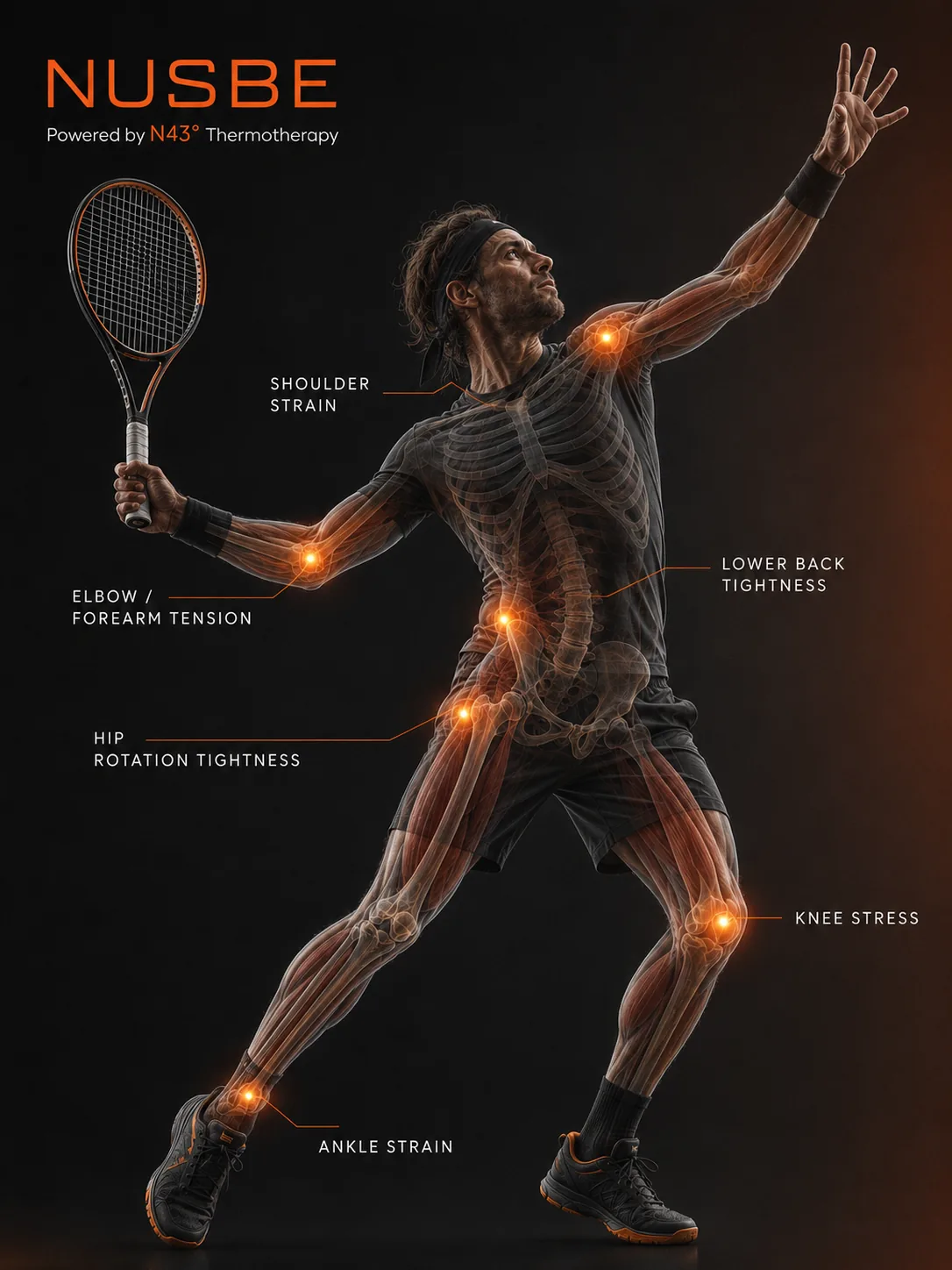
Upper body and lower body, in the same match
Most sports load one end of you harder than the other. Tennis is unusual in asking for both at full effort in the same two hours.
- Shoulder. Every serve and overhead accelerates the arm, then has to slow it down again. That second half is the demanding part. - Elbow and forearm. Grip pressure across a long match, plus the impact of the ball through the strings. - Lower back. Serving is a coil and release through the trunk, repeated every service game. - Hips. Sliding wide and pushing back to the centre, over and over. - Knees and ankles. The split step before every shot, then the stop and change of direction.
Soreness across those areas after a hard match is a normal training response.
How long it usually lasts
| What you feel | What it usually means |
|---|---|
| Broad ache in the shoulder and legs the next morning | Typical match soreness |
| Stiffness that eases once you warm up | Typical |
| Sharp catch at one point in the serve | Worth professional assessment |
| Pain at one spot on the elbow, or a swollen ankle | See a healthcare professional |
What actually helps
- Space your court days. Playing several days in a row is the most common cause of soreness that never clears, particularly in the shoulder. - Warm the shoulder and hips up before serving hard, rather than using the first service game as the warm-up. - Ease the grip. A tighter grip does not produce a better shot and it loads the forearm across every rally. - Build playing hours gradually, especially returning after a break. - Warmth for stiffness. With no acute swelling, controlled warmth may help ease stiffness in the shoulder, lower back and legs between sessions.
Malaysian court conditions
Most local tennis is played outdoors in heat and humidity, or indoors without strong air conditioning. Fluid loss over two hours is higher than most players assume, and finishing well down on fluid reliably makes the next day feel worse. Drinking steadily through the match beats catching up afterwards.
Where NUSBE fits
A guided NUSBE session applies controlled, comfortable warmth to the areas you choose — commonly shoulder, lower back and legs after a match week — at the same temperature and coverage every time.
This is recovery and comfort support. It is not treatment, and it does not replace care from a qualified healthcare professional.
Frequently asked questions
How long should soreness last after tennis?
For most players it peaks around 24 to 48 hours after playing and eases within a few days. Soreness that is sharp, does not settle after several days, or comes with swelling deserves assessment by a healthcare professional.
Why does my shoulder and my legs hurt after the same match?
Tennis is one of the few sports that loads the upper and lower body heavily at once. The serve and overheads work the shoulder, while split steps and wide chases load the legs. A long match does both hundreds of times.
Is one-sided soreness normal in tennis?
Some asymmetry is expected, because almost everything is played on one side. Soreness that is consistently one-sided and getting worse week to week is worth a professional opinion rather than another week of play.
Does warmth help after tennis?
Once there is no acute swelling, warmth may help ease stiffness. Research on post-exercise soreness found heat applied within about an hour of finishing may reduce how sore you feel the next day.
Evidence referenced in this guide
- Wang Y et al., Physical Therapy in Sport 2021 — meta-analysis of 32 randomised trials on heat and cold for post-exercise muscle soreness.
- Network meta-analysis of cold and heat therapies for DOMS, 2022 — hot packs ranked highest for early soreness relief.
See the research behind our recovery claims on the science page.