
Why you're sore after a long run, and how long it lasts
Long-run soreness comes from thousands of impact repetitions rather than any single hard effort, so it lands in the quads, calves, hamstrings and lower back. It usually peaks a day or two afterwards and settles within a few days. Rehydrating, easy movement, gradual mileage increases and warmth on stiff areas are the practical basics.
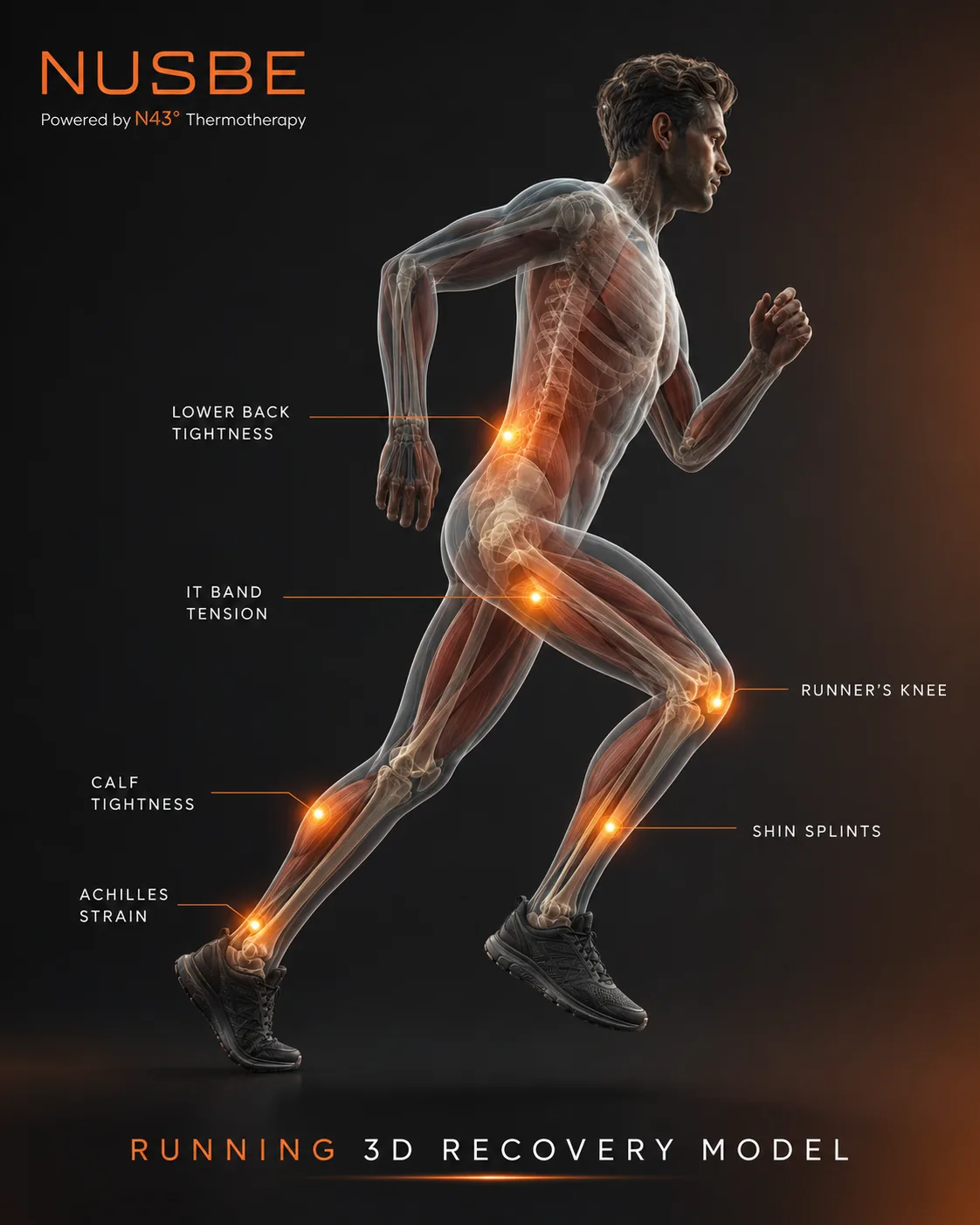
It is the repetition, not the effort
A long run rarely feels hard in the way an interval session does. That is exactly why the soreness surprises people.
The load in a long run is volume: thousands of steps, each one absorbing impact through the same tissue. Nothing about any individual step is demanding. Twelve thousand of them is.
Where it lands:
- Quads. Absorbing impact on every step, more so on any downhill.
- Calves and Achilles. Push-off, repeated for the whole distance.
- Hamstrings. Controlling the leg at the end of each stride.
- Lower back. Holding posture as form deteriorates late in the run.
Why Monday is worse than Sunday
Soreness typically peaks 24 to 48 hours afterwards. If you run long on Sunday morning and feel fine that evening, Monday will often be the worst day. This is normal and does not mean something went wrong.
What actually helps
- Rehydrate properly. In Malaysian humidity, most runners finish a long run well down on fluid, and it makes the next day worse. - Move the next day. A walk or very easy jog beats sitting still. - Build mileage gradually. A sudden jump in weekly distance is the single most common reason soreness lingers all week. - Do not stack hard days. A long run followed by a hard session the next day is the classic mistake. - Warmth for stiffness. With no acute swelling, controlled warmth may help ease stiffness in the quads and calves.
When it is not just soreness
See a qualified healthcare professional if pain is sharp rather than broad, if it concentrates in one specific point, if it worsens as you run rather than easing, or if it returns to the same place every week.
Where NUSBE fits
A guided NUSBE session applies controlled, comfortable warmth to the quads, calves and lower back at a consistent temperature and coverage. Runners commonly book it on the evening of their long run day.
This is recovery and comfort support. It is not treatment, and it does not replace care from a qualified healthcare professional.
Frequently asked questions
Why does soreness peak two days after a long run?
Post-exercise soreness commonly peaks 24 to 48 hours afterwards rather than immediately. Long runs are a clear example, which is why Monday often feels worse than Sunday evening.
Should I run the day after a long run?
An easy short run or a walk usually leaves you feeling better than complete rest. Running hard the day after a long run is the most common reason soreness never fully clears.
Why are my quads sore when I ran on the flat?
Even flat running involves absorbing impact on every step, and over a long run that repeats thousands of times. Downhill sections make it more pronounced, but flat volume alone is enough.
Does warmth help after a long run?
With no acute swelling, warmth may help ease stiffness in the quads and calves. Research found heat applied within about an hour of finishing may reduce next-day soreness.
Evidence referenced in this guide
- Wang Y et al., Physical Therapy in Sport 2021 — meta-analysis of 32 randomised trials on heat and cold for post-exercise muscle soreness.
- Network meta-analysis of cold and heat therapies for DOMS, 2022 — hot packs ranked highest for early soreness relief.
See the research behind our recovery claims on the science page.