
Grip, forearms and shoulders in HYROX training
Grip is the limiter in HYROX far more often than leg strength, because farmers carry, sled pull and ski erg all draw on the same forearms across a single race. Building carry volume gradually, spacing heavy grip work and warmth on the forearms and shoulders are the practical levers.
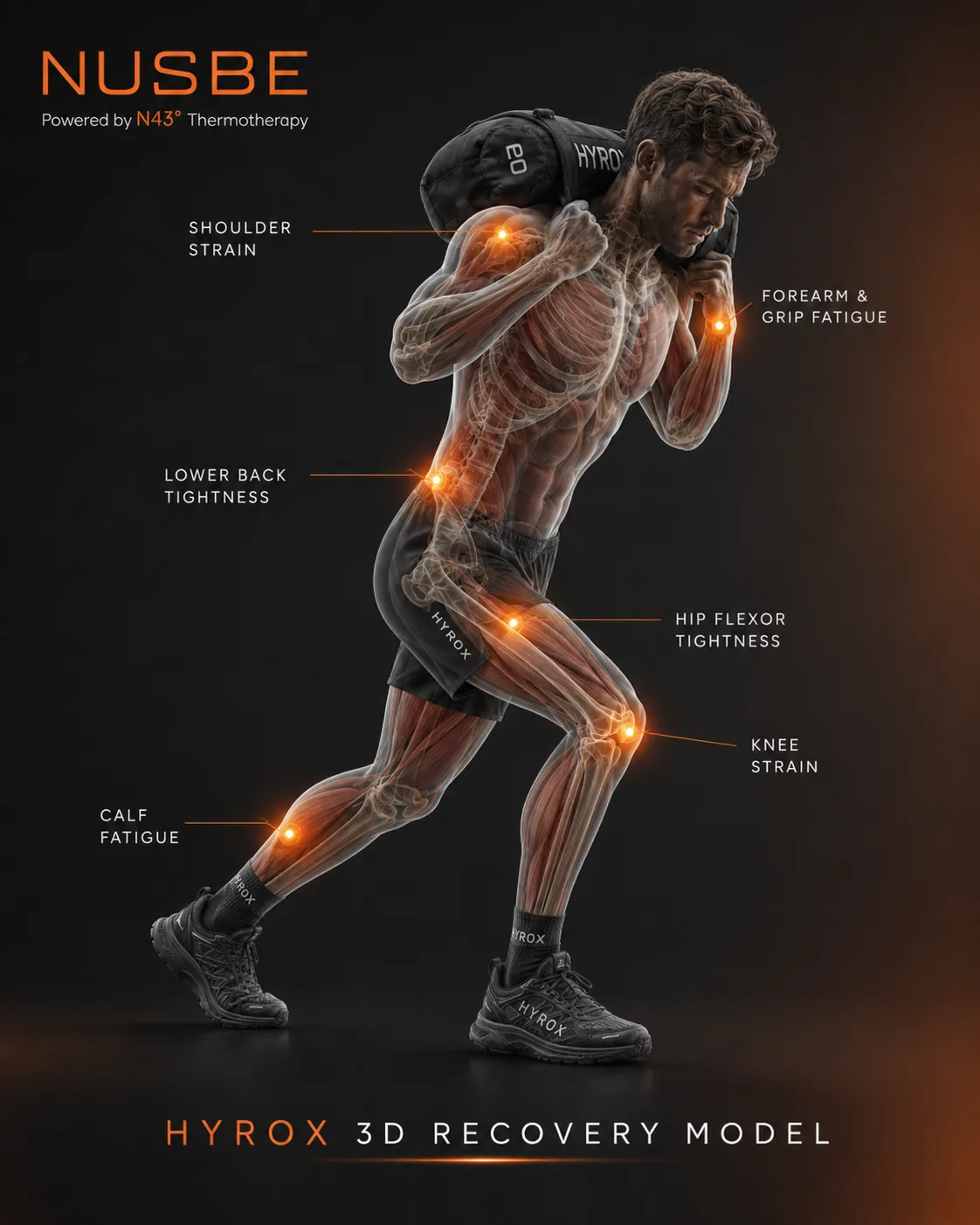
Grip is the quiet limiter
Ask athletes what they expect to fail in a race and most say legs or lungs. Ask them afterwards what actually failed and a large share say grip.
The reason is structural. Farmers carry, sled pull and ski erg all draw on the same forearm muscles, and they are spread across the race so those muscles never get a genuine break. The legs at least get a different stimulus during the running segments. The forearms get none.
What accumulates where
| Station | Upper-body load |
|---|---|
| Farmers carry | Forearms, grip, upper back, shoulders |
| Sled pull | Forearms, grip, lats, lower back |
| Ski erg | Shoulders, lats, upper back |
| Sandbag lunges | Upper back, shoulders, trunk |
| Wall balls | Shoulders, on top of everything above |
Read down that column and the pattern is obvious: five of the eight stations ask something of the same upper body, and there is no recovery window inside the race.
What supports recovery
- Build carry volume gradually rather than testing maximal carries often. - Do not stack heavy grip stations on consecutive days. - Warm the shoulders up before ski erg or wall ball work. - Vary grip work so it is not the identical pattern every session. - Warmth for stiffness. With no acute swelling, controlled warmth may help ease tightness in the forearms, shoulders and upper back between sessions.
When to stop self-managing
See a qualified healthcare professional if pain concentrates at one specific point around the elbow, if gripping everyday objects is painful, if shoulder pain wakes you at night, or if there is weakness lifting the arm.
Those are different from the broad tightness that follows a hard session, and warmth is not the answer to them.
Where NUSBE fits
A guided NUSBE session applies controlled, comfortable warmth to the forearms, shoulders and upper back at a consistent temperature and coverage.
This is recovery and comfort support. It is not a medical assessment, and it does not replace care from a qualified healthcare professional.
Frequently asked questions
Why does my grip fail before my legs?
Several stations draw on the same forearm muscles, and unlike the legs they get no relief during the running segments. Grip is cumulative across a race in a way most athletes underestimate.
How do I train grip without constant forearm soreness?
Building carry volume gradually and not stacking heavy grip stations on consecutive days is the practical approach. A coach can structure this around your race timeline.
Why do my shoulders ache after ski erg sessions?
The ski erg is largely upper body, and the pull repeats hundreds of times per session. Combined with sandbag and wall ball work, the shoulders accumulate more than most athletes plan for.
Is elbow pain the same as forearm soreness?
No. General forearm tightness is broad and eases with rest. Pain concentrated at one point around the elbow that persists is a recognised condition and deserves professional assessment.
Evidence referenced in this guide
- Wang Y et al., Physical Therapy in Sport 2021 — meta-analysis of 32 randomised trials on heat and cold for post-exercise muscle soreness.
- Network meta-analysis of cold and heat therapies for DOMS, 2022 — hot packs ranked highest for early soreness relief.
See the research behind our recovery claims on the science page.