
Why you're sore after swimming, and how long it lasts
Swimming has almost no impact, but the shoulders, upper back and neck do thousands of repetitions per session, so soreness concentrates there rather than in the legs. It usually peaks a day or two after a hard set and settles within a few days. Gradual volume increases, easy movement and warmth on stiff areas are the practical basics.
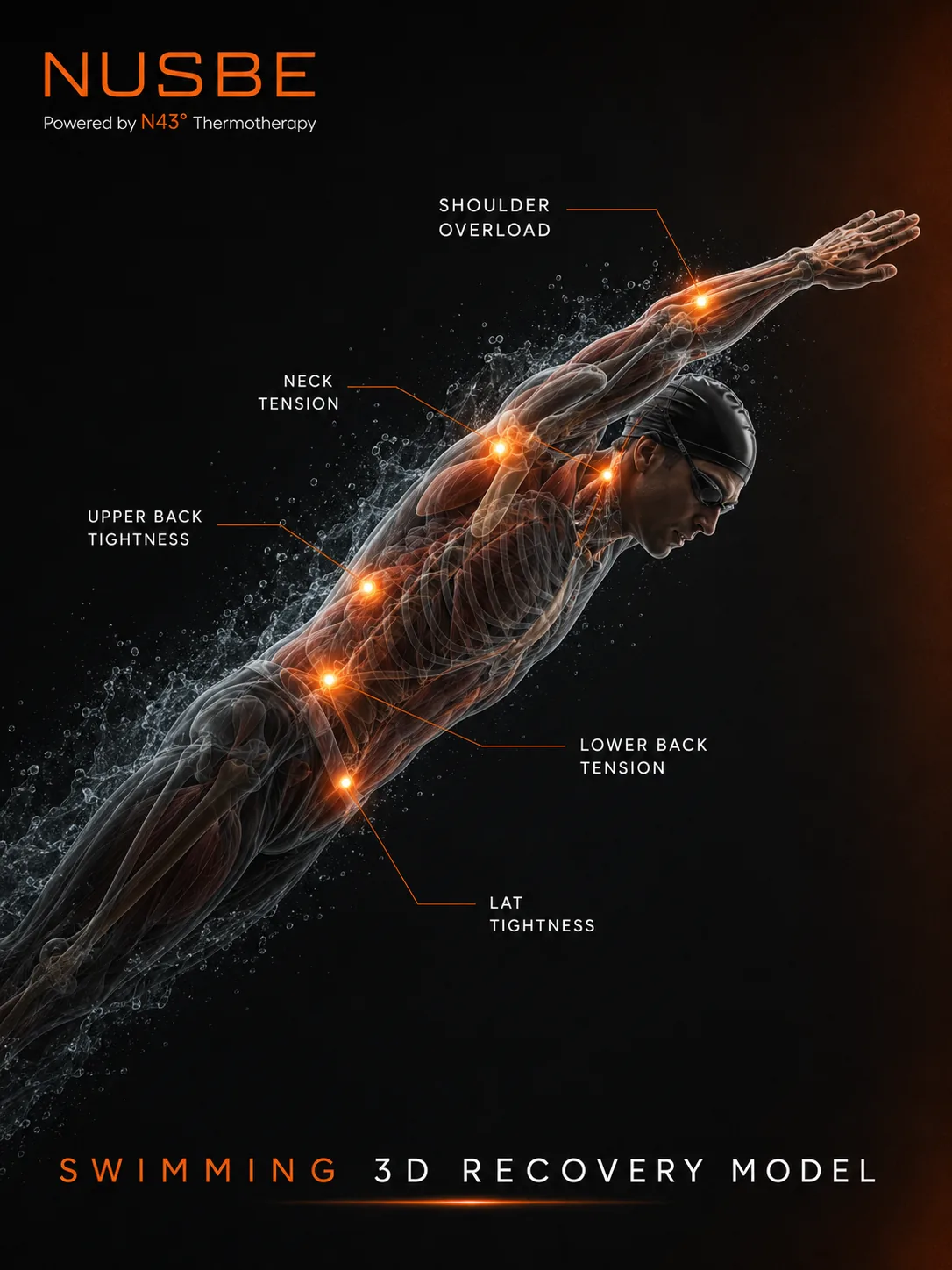
Low impact is not low load
Swimming gets recommended as the gentle option, and for joints that is fair. For muscles it is misleading.
A moderate one-hour session can involve well over a thousand stroke repetitions per arm. Nothing in land-based training comes close to that repetition count, and the shoulders and upper back produce every single one.
That is why the soreness pattern in swimming looks nothing like running:
- Shoulders and lats. Every stroke is pulled through them. - Upper back and between the shoulder blades. Holding position and recovering the arm. - Neck. Rotating to breathe, usually to the same side every time. - Lower back. Holding a streamlined position, especially as you fatigue. - Calves. Cramping and tightness from ankle-driven kicking.
How long it usually lasts
| What you feel | What it usually means |
|---|---|
| Broad ache across shoulders and upper back next day | Typical training soreness |
| Neck stiffness on your breathing side | Common; worth varying your breathing |
| Sharp catch at a specific point in the stroke | Worth professional assessment |
| Shoulder pain that wakes you at night, or weakness | See a healthcare professional |
The bottom row matters. Persistent shoulder pain is the most-studied complaint in swimming, with established care pathways. It is not something warmth answers.
What actually helps
- Build distance gradually. A sudden jump in weekly volume is the single most common cause of shoulder trouble in adult swimmers. - Vary your breathing side. Breathing bilaterally spreads neck rotation across both sides instead of loading one. - Warm up before hard sets rather than starting a main set cold. - Get technique looked at if soreness always lands in the same place. A coach's eye often solves what recovery cannot. - Warmth for stiffness. With no acute swelling, controlled warmth may help ease stiffness across the shoulders and upper back between sessions.
Where NUSBE fits
A guided NUSBE session applies controlled, comfortable warmth to the shoulders, upper back and lower back at a consistent temperature and coverage.
This is recovery and comfort support. It is not treatment, and it does not replace care from a qualified healthcare professional.
Frequently asked questions
Why am I sore after swimming when there is no impact?
Low impact is not low load. A single session can involve thousands of stroke repetitions, and the shoulders and upper back produce every one of them. Volume, not impact, is what makes you sore.
Why my shoulders and not my legs?
In freestyle most propulsion comes from the upper body. The legs contribute less and are largely along for the ride, which is why the shoulders and lats usually complain first.
How long should swimming soreness last?
For most swimmers it peaks around 24 to 48 hours and eases within a few days. Shoulder pain that is sharp during a specific part of the stroke, or that wakes you at night, deserves professional assessment.
Does warmth help after swimming?
With no acute swelling, warmth may help ease stiffness in the shoulders and upper back. Research on post-exercise soreness found heat applied within about an hour of finishing may reduce next-day soreness.
Evidence referenced in this guide
- Wang Y et al., Physical Therapy in Sport 2021 — meta-analysis of 32 randomised trials on heat and cold for post-exercise muscle soreness.
- Network meta-analysis of cold and heat therapies for DOMS, 2022 — hot packs ranked highest for early soreness relief.
See the research behind our recovery claims on the science page.