
Why you're sore after badminton, and how long it lasts
Badminton soreness comes from overhead smashes, deep lunges and constant direction changes, so it lands in the shoulder, forearm, lower back, knees and ankles. For most players it peaks a day or two after playing and settles within a few days. Easy movement, sleep and warmth on stiff areas are the practical basics.
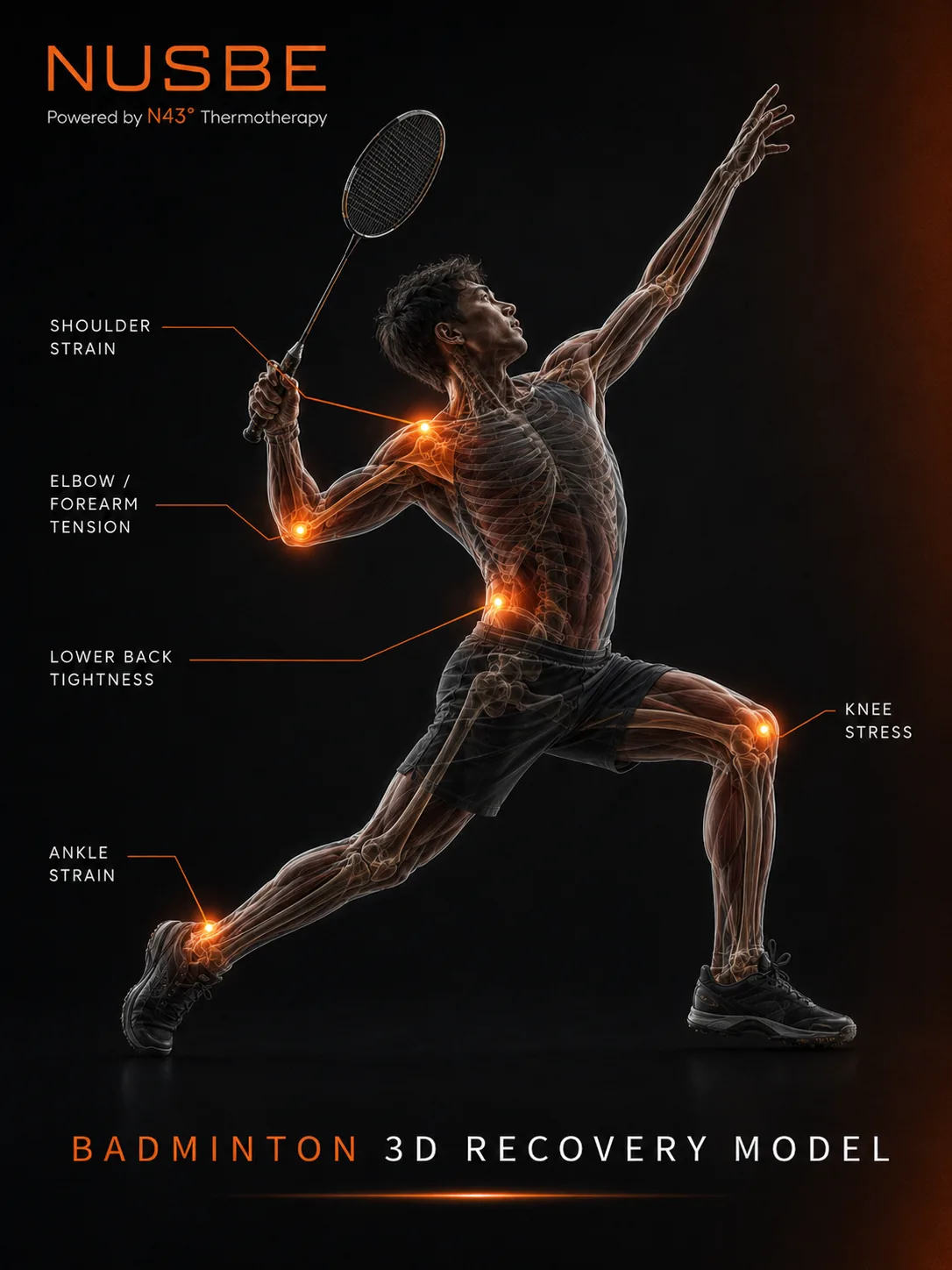
A small court, a very high workload
Badminton looks compact from the sideline. What the court size hides is the sheer number of movements: a single rally can involve half a dozen lunges, split-steps and overhead swings, and a social session runs to hundreds.
That pattern loads a predictable set of areas.
- Shoulder. Smashes and clears accelerate the racquet, then slow the arm down — the second half being the demanding part. - Forearm and wrist. Grip and racquet control across a long session. - Lower back. Overhead reaching and rotation, repeated from a low ready position. - Knees and quads. Deep lunges to the net and recovery steps back. - Ankles. Split-steps and rapid direction change.
Soreness across these areas after a hard session is a normal training response.
How long it usually lasts
| What you feel | What it usually means |
|---|---|
| General ache across shoulder and legs, worse the next day | Typical session soreness |
| Stiffness that eases as you warm up | Typical |
| Sharp catch in the shoulder during a smash | Worth professional assessment |
| Swelling, giving way, or pain that wakes you | See a healthcare professional |
What actually helps
- Cool down before you leave. A few minutes of easy movement and gentle stretching beats going straight to the car. - Space your sessions. Playing several long evenings back to back is the most common cause of soreness that stacks up. - Loosen the grip. Many players hold the racquet far tighter than the shot requires, which adds forearm load for no benefit. - Warmth for stiffness. With no acute swelling, controlled warmth may help ease stiffness in the shoulder, back and legs before your next session. - Protect sleep, particularly after late-night courts — a very common Malaysian playing pattern.
Where NUSBE fits
A guided NUSBE session applies controlled, comfortable warmth to the areas you choose — commonly shoulder, lower back or quads after a badminton week — at the same temperature and coverage every time.
This is recovery and comfort support. It is not treatment, and it does not replace care from a qualified healthcare professional.
Frequently asked questions
How long should soreness last after badminton?
For most players it peaks around 24 to 48 hours after playing and eases within a few days. Soreness that is sharp, does not settle after several days, or comes with swelling deserves assessment by a healthcare professional.
Why does my shoulder feel it most?
Smashes and clears ask the shoulder to accelerate the racquet and then slow the arm down again, repeated across every rally. That combination is demanding, which is why the shoulder is often the first area players notice.
Why are my legs sore when the court is small?
Badminton involves constant lunging, split-stepping and recovery steps. The court is small, but the number of direction changes per rally is very high, which loads the knees, quads and ankles heavily.
Does warmth help after badminton?
Once there is no acute swelling, warmth may help ease stiffness. Research on post-exercise soreness found heat applied within about an hour of finishing may reduce how sore you feel the next day.
Evidence referenced in this guide
- Wang Y et al., Physical Therapy in Sport 2021 — meta-analysis of 32 randomised trials on heat and cold for post-exercise muscle soreness.
- Network meta-analysis of cold and heat therapies for DOMS, 2022 — hot packs ranked highest for early soreness relief.
See the research behind our recovery claims on the science page.