
Downhill hiking, quads and knees
Descending loads the quads and knees far more than climbing does, because the muscles work while lengthening to control your body weight down the slope. Poles, shorter steps, gradual build-up and warmth on stiff areas all help. Sharp or persistent knee pain on descent deserves professional assessment.
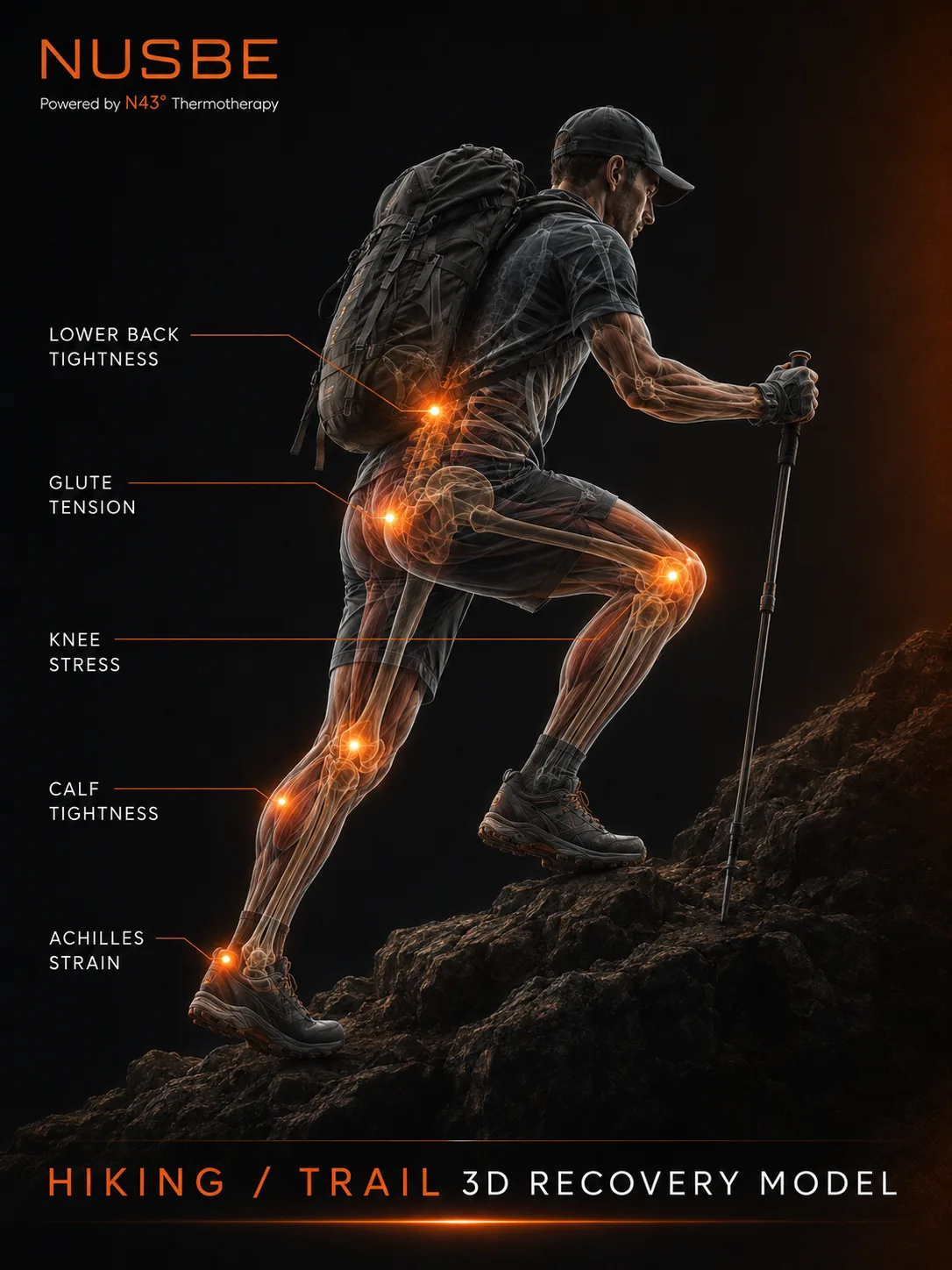
Two different jobs
Uphill, your quads shorten to lift you. Downhill, they lengthen while still under load, working as a brake against gravity with every step.
Both are hard. Only one of them leaves you unable to walk down stairs comfortably two days later.
That is the whole explanation for the most confusing thing about hiking soreness: the part that felt easier at the time is the part you feel afterwards.
What makes a descent more demanding
- Steepness. The steeper the ground, the more braking per step.
- Length. A long descent accumulates thousands of these steps.
- Loose or uneven ground, where each step also needs stabilising.
- A heavy pack, which adds to every single braking step.
- Fatigue, because control drops off and steps get heavier.
What helps on the trail
- Use poles. On steep descents they shift a meaningful portion of the load to the arms. - Shorten your stride. Controlled steps beat long drops. - Do not rush the descent. Most knee complaints come from hurrying down because the day is nearly over. - Build downhill exposure gradually. If you rarely hike, a full-day summit trail is a big first descent.
Afterwards
Rehydrate, keep moving gently the following day rather than sitting completely still, and apply warmth to the quads and calves once there is no acute swelling. Research suggests warmth within about an hour of finishing may reduce how sore you feel the next day.
Expect stairs to be unpleasant for a day or two. That part is normal.
When to get it looked at
See a qualified healthcare professional if knee pain is sharp rather than general, if the knee swells, if it gives way, or if it returns on every descent regardless of how gradually you build up.
Where NUSBE fits
A guided NUSBE session applies controlled, comfortable warmth to the quads and around the knee at a consistent temperature and coverage.
This is recovery and comfort support. It is not a medical assessment, and it does not replace care from a qualified healthcare professional.
Frequently asked questions
Why does downhill hurt more than uphill the next day?
Going up, muscles shorten to lift you. Going down, they lengthen under load to lower you. That second pattern reliably produces more delayed soreness, which is why the descent is what you feel two days later.
Do trekking poles actually help?
Hikers commonly report noticeably less quad and knee load on steep descents when using poles, because some of the force goes through the arms instead. On long descents most people find the difference obvious.
Should I take smaller steps going down?
Shorter, more controlled steps generally reduce peak impact compared with long dropping strides. It is slower, and most people's knees prefer it on steep ground.
When is knee pain more than soreness?
If it is sharp rather than general, if it appears at a specific point in the movement, if the knee swells, or if it keeps returning on every descent, see a qualified healthcare professional.
Evidence referenced in this guide
- Wang Y et al., Physical Therapy in Sport 2021 — meta-analysis of 32 randomised trials on heat and cold for post-exercise muscle soreness.
- Network meta-analysis of cold and heat therapies for DOMS, 2022 — hot packs ranked highest for early soreness relief.
See the research behind our recovery claims on the science page.