
Golf shoulder and forearm fatigue across a season
Shoulder and forearm fatigue in golf builds across weeks rather than in one round: repeated swings load the lead shoulder, and grip pressure loads the forearms. Easing grip, spacing range volume and warmth on stiff areas help. Persistent elbow or shoulder pain deserves professional assessment.
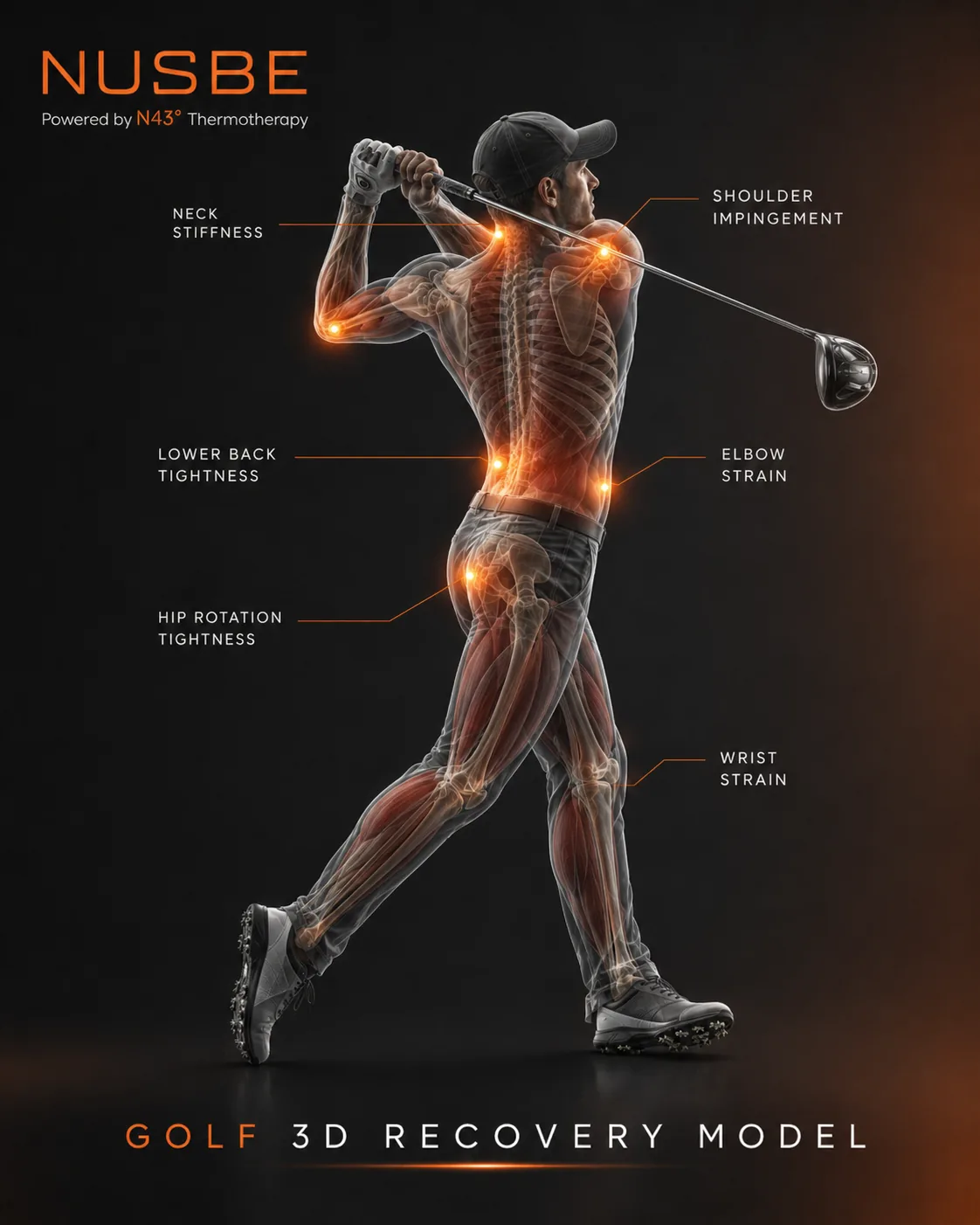
Season load, not round load
Golf shoulders and forearms rarely complain about a single round. They complain about a month of rounds plus range sessions, where the volume quietly climbs and nothing ever fully settles.
- Lead shoulder travels through the most range and controls the club through impact. - Forearms hold grip pressure for the entire session and absorb impact through the club. - Range sessions concentrate both, because you swing repeatedly with none of the walking that breaks a round up.
What tends to make it worse
- Gripping too tightly. The most common and most fixable contributor. - Long range sessions late in the week, on top of weekend rounds. - Hitting off mats repeatedly, which transmits more back up the arms than turf. - A sudden increase in playing frequency, such as a competition block.
What supports recovery
- Ease the grip. Lighter grip pressure genuinely reduces forearm load, and most players find it does not cost them distance. - Space range volume rather than stacking it beside rounds. - Warm up the shoulder before hitting hard. - Warmth for general tightness. With no acute swelling, controlled warmth may help ease stiffness in the shoulder and forearm between sessions.
When to stop self-managing
Please see a qualified healthcare professional if elbow pain is tender over one specific point, if gripping everyday objects hurts, if shoulder pain wakes you at night, or if either is getting worse week on week.
Those are recognised conditions with established care pathways, and warmth is not the answer to them.
Where NUSBE fits
A guided NUSBE session applies controlled, comfortable warmth to the shoulder, upper back and forearm at a consistent temperature and coverage — useful across a busy competition block.
This is recovery and comfort support. It is not a medical assessment, and it does not replace care from a qualified healthcare professional.
Frequently asked questions
Why is my lead shoulder the one that complains?
The lead shoulder travels through the most range in the backswing and controls the club through impact and follow-through, so it typically accumulates more work than the trail side.
Why do my forearms ache after a range session?
Grip pressure held across a long session, plus impact through the club, loads the muscles running along the forearm. Range sessions concentrate this more than rounds because there is no walking between shots.
Is golfer's elbow the same as general forearm tightness?
No. General tightness is broad and eases with rest. Pain concentrated at a specific point on the elbow that persists or worsens week on week is a recognised condition and should be assessed by a healthcare professional.
Does warmth help?
For general tightness with no acute swelling, warmth may help ease stiffness in the shoulder and forearm and make the area feel less tense between sessions.
Evidence referenced in this guide
- Wang Y et al., Physical Therapy in Sport 2021 — meta-analysis of 32 randomised trials on heat and cold for post-exercise muscle soreness.
- Network meta-analysis of cold and heat therapies for DOMS, 2022 — hot packs ranked highest for early soreness relief.
See the research behind our recovery claims on the science page.