
Jumping, landing and knee load in basketball
The landing loads the knee far more than the jump does, and a game involves dozens of them. General post-game knee stiffness usually settles in a few days. Knee pain concentrated just below the kneecap that returns every session is a recognised pattern in jumping sports and deserves professional assessment rather than another warm-up.
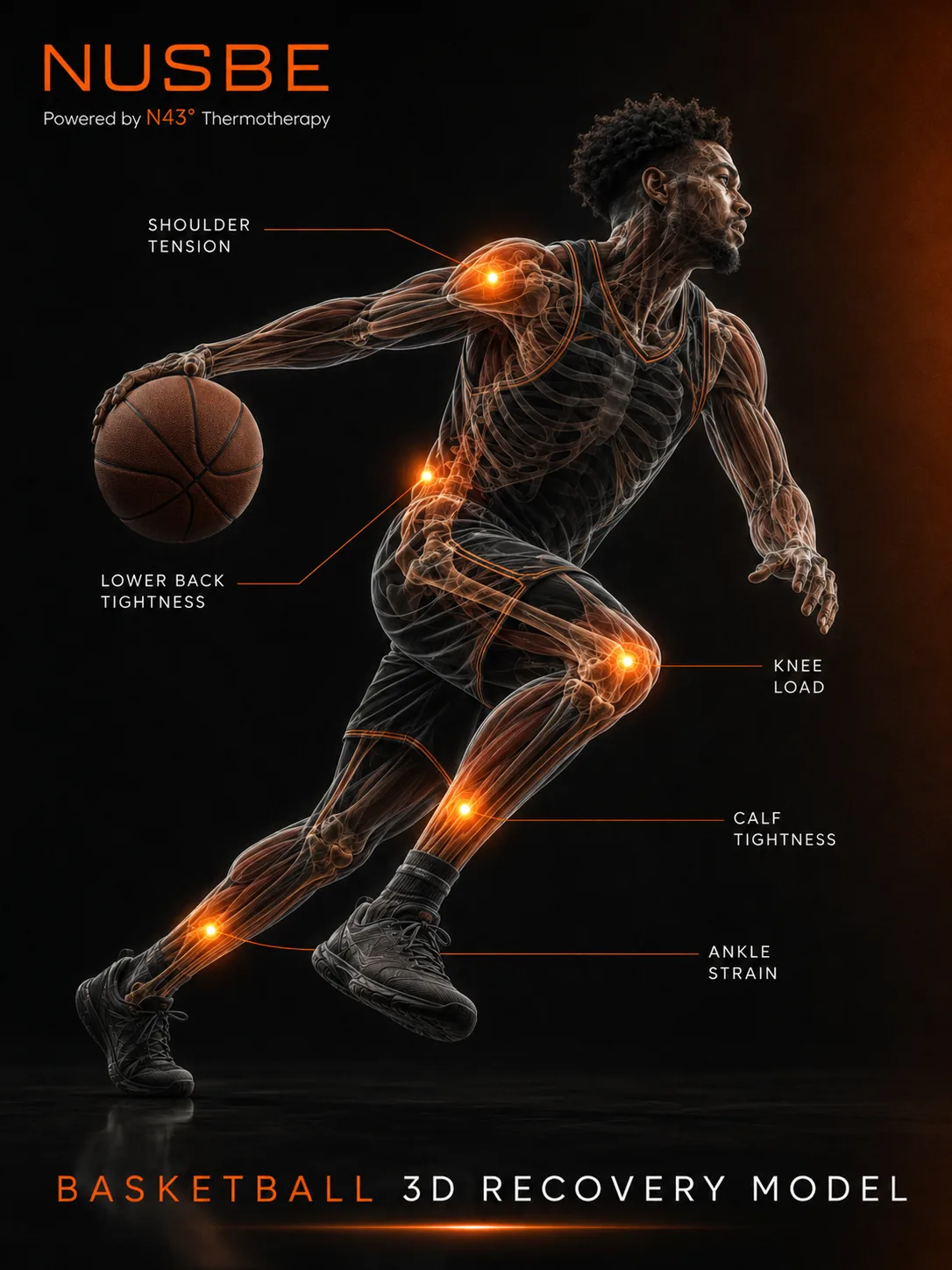
The landing is the expensive part
Players think about their vertical. The knees care more about what happens on the way down.
Producing a jump is hard work, but absorbing your body weight on landing generates higher forces through the knee and quad — and a competitive game involves dozens of landings, most of them unplanned, some of them off balance or into contact.
That is why knee complaints in basketball track landing volume far more closely than they track how high anyone jumps.
What raises the load
- Playing several days in a row, so the tissue never gets a recovery day.
- Hard court surfaces, which return more force than sprung floors.
- Returning after a break and playing a full game immediately.
- Fatigue late in a game, when landing control drops off.
What supports recovery
- Space heavy sessions. This is the single most effective lever. - Build back gradually after any layoff rather than playing a full game straight away. - Strength work over time. Progressive leg strengthening supports the knee across a season; a professional can guide something suitable. - Warmth for stiffness. With no acute swelling, controlled warmth may help ease stiffness around the knee and quad between sessions.
When to stop self-managing
See a qualified healthcare professional if pain sits in one specific point just below the kneecap, if it returns every session, if it worsens week on week, or if the knee swells or gives way.
That pattern is well recognised in jumping sports and has established care pathways. Warmth is not the answer to it.
Where NUSBE fits
A guided NUSBE session applies controlled, comfortable warmth to the quads and around the knee at a consistent temperature and coverage. Players often book it the day after their heaviest game.
This is recovery and comfort support. It is not a medical assessment, and it does not replace care from a qualified healthcare professional.
Frequently asked questions
Is it the jumping or the landing that loads the knee?
Mostly the landing. Producing a jump is demanding, but absorbing body weight on the way down generates higher forces, which is why landing volume tracks knee complaints more closely than jump height.
What is jumper's knee?
Players use the term for pain concentrated just below the kneecap, common in jumping sports. It is a recognised condition and, if it persists or returns every session, should be assessed by a healthcare professional rather than self-managed.
Should I stop playing if my knees ache after games?
General stiffness that eases with movement is usually normal training response. Pain that is sharp, localised below the kneecap, or worsening week on week is different and worth getting looked at.
Does warmth help knee stiffness?
With no acute swelling, warmth may help ease general stiffness around the knee and quad and make the area feel less guarded before your next session.
Evidence referenced in this guide
- Wang Y et al., Physical Therapy in Sport 2021 — meta-analysis of 32 randomised trials on heat and cold for post-exercise muscle soreness.
- Network meta-analysis of cold and heat therapies for DOMS, 2022 — hot packs ranked highest for early soreness relief.
See the research behind our recovery claims on the science page.