
Ankles and calves after court sessions
Cutting, pivoting and stopping on a hard court concentrate load in the ankles and calves, which is why they often feel heaviest the morning after playing. Easy movement, spacing court sessions and warmth on stiff areas help. Swelling or instability after rolling an ankle is different and needs professional assessment before you play again.
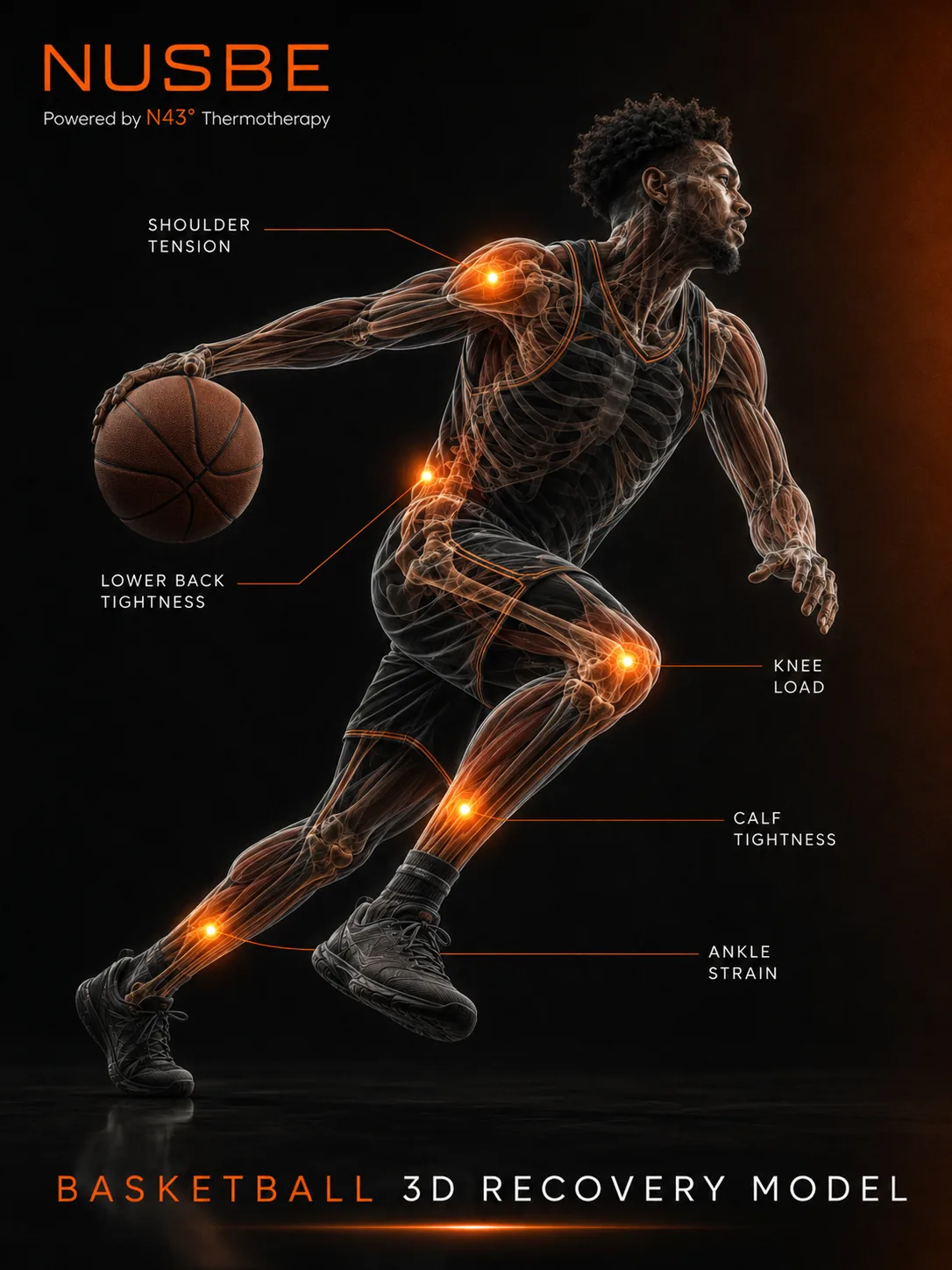
The court gives force back
Basketball almost never lets you move in a straight line. Every possession has a stop, a start, a pivot or a cut, and each one is a small high-force event through the ankle and calf.
The surface decides how much of that force comes back at you.
- Sprung indoor floors absorb a portion of each landing.
- Concrete and outdoor courts return most of it up the leg.
That single difference explains a lot of soreness patterns. Players who move from an indoor league to weekend outdoor games often report their calves feeling noticeably heavier without changing anything else about how they play.
A practical routine between sessions
| When | What to do |
|---|---|
| Straight after | A few minutes of easy walking before you sit down |
| That evening | Gentle calf and ankle range of movement; protect sleep |
| Next day | Easy movement rather than complete rest |
| Between sessions | Warmth on whatever stays stiff, once there is no swelling |
Research on post-exercise soreness suggests warmth applied within about an hour of finishing may reduce how sore you feel the next day, so starting sooner tends to work better than leaving it to the following evening.
The ankle rule
Ankle rolls are the most common complaint in basketball. The rule is simple and worth following: if it swelled, if it feels unstable, if it gives way, or if you cannot put weight through it, see a qualified healthcare professional before playing again.
General stiffness after a hard game is a different thing entirely.
Where NUSBE fits
A guided NUSBE session applies controlled, comfortable warmth to the calves and lower legs at a consistent temperature and coverage.
This is recovery and comfort support. It is not treatment, and it does not replace care from a qualified healthcare professional.
Frequently asked questions
Why do my calves feel heavy after basketball?
Every stop, start and jump pushes off through the calf, and a game involves dozens. On a hard court that force comes straight back up, which is why the lower legs often feel it most the next morning.
Does court surface matter?
Players commonly report more calf and ankle load on concrete or outdoor courts than on sprung indoor floors. If your soreness changed when your venue did, that is worth noting.
I rolled my ankle and it swelled. Can I keep playing?
Please have it assessed by a healthcare professional first. Playing on a swollen ankle is a common route from a short problem to a recurring one, and warmth is not the answer to acute swelling.
What helps between court sessions?
Easy movement rather than complete rest, sensible spacing of hard sessions, and warmth on whatever stays stiff once any acute swelling has settled.
Evidence referenced in this guide
- Wang Y et al., Physical Therapy in Sport 2021 — meta-analysis of 32 randomised trials on heat and cold for post-exercise muscle soreness.
- Network meta-analysis of cold and heat therapies for DOMS, 2022 — hot packs ranked highest for early soreness relief.
See the research behind our recovery claims on the science page.